Generic selectors
Exact matches only
Search in title
Search in content
Post Type Selectors

Category: news

How Goes the Flow?

Two figures with kayaks in a creek, mud and marsh grass on either bank. An inset photo on the lower left corner shows a cylinder laying flat attached to a wooden backing with rope
Jonah Rigdon (L) and Daniela Di Iorio (R) in South End Creek with the ADCP (inset shows instrument and frame).

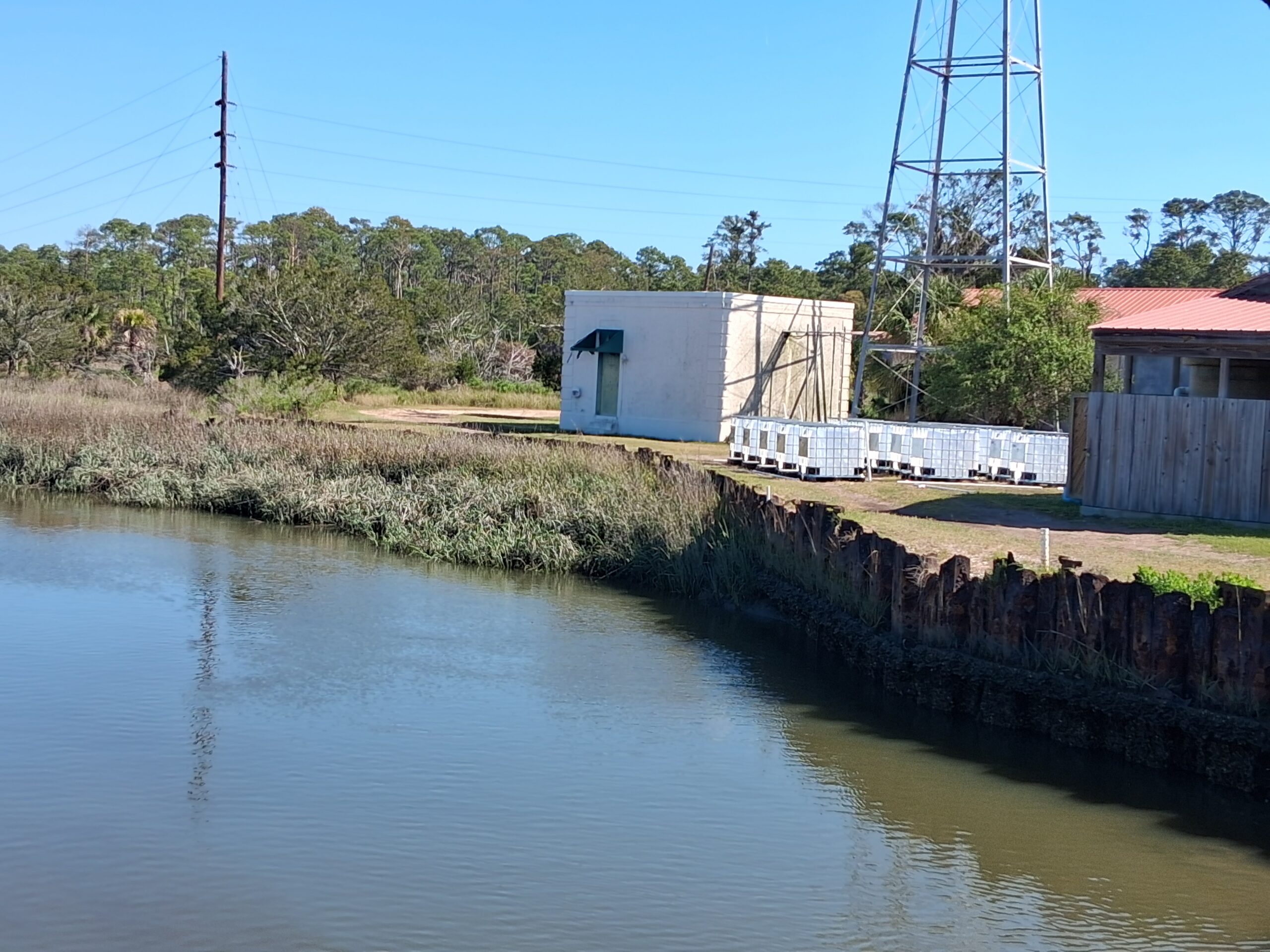
The UGAMI campus is bordered by South End Creek, which runs past the Power House before connecting to Doboy Sound. The creek has a bulkhead along most of its length to prevent erosion and protect the campus from flooding. However, the bulkhead has been in place for more than 40 years old and parts of it are severely deteriorating. UGAMI is partnering with the Sapelo Island National Estuarine Research Reserve on a design that would allow us to replace much of the structure with a living shoreline, which is a nature-based solution that uses marsh vegetation and oysters. This past week we worked with Daniela Di Iorio (Professor, Dept. of Marine Sciences) to deploy an acoustic doppler current profiler (ADCP) to collect high-frequency data on current flow in the creek for the next 60 days. This data will be important for our design, as it will give us information on “how goes the flow”.

UGAMI Double Feature!

Graduate student jumping in front of a prototype for a precipitation manipulation experiment, a series of pvc and plastic sheeting comprising the large structure
Photo credit: Romi Drubetskoy

We wanted to share two different recent posts that featured the UGA Marine Institute. First, Eamon Hennessy (a PhD student at Univ. of Houston) and Romi Drubetskoy (an undergraduate intern from Georgetown Univ.) to write up a “Day in the Life: Behind the Scenes on Sapelo Island”, detailing their research with the Georgia Coastal Ecosystems LTER, ranging from building a prototype for a precipitation manipulation experiment to cooling out on the beach at the end of a busy day. Second, the Organization of Biological Field Stations (OBFS) highlighted UGAMI on their Instagram account.

Check them out!

Eleven students smiling on the Teal Boardwalk over the marsh at sunset, arranged poking their heads out from behind each other, a beautiful orange sky behind them

UGA Marine Institute @ UGA Study Away Fair

The UGA Global Engagement Office hosted a two-day Study Away Fair at the Tate Student Center in Athens on September 16 and 17, 2025. The fair allowed UGAMI to showcase our residential programs, including Marine Biology (Spring 2026), Salt Marsh (Maymester 2026), and Coastal Ecology (Summer 2026), as well as internships available on Sapelo Island. Several alumni from the Coastal Summer 2025 program were present to share their experiences with attendees. The Study Away Fair is an annual event that typically hosts over 50 exhibitors, including UGA faculty programs, international partners, and domestic field study programs. Events like these allow us to broaden UGAMI’s presence on campus in Athens and expand our networks with international institutions that offer similar programs.

Student sitting outside under a tent at the Study Away Fair, behind a table covered in a black tablecloth emblazoned with the UGA Arches logo and the words "Marine Institute University of Georgia". There are photos, flyers, pens, and stickers available on the table for interested students.
Summer 2025 student Vivian Poley assisting at the Study Away Fair.

List of alumni helpers:

Vivian Poley, Victoria Cone, Riley Casteel, Bianca Christy, Darion Deviez, Alaina Campbell

Housing Renovations Complete!

Six photos of the exteriors and interiors of the renovated apartments and the new cottages

It has been long time coming, but we are proud to announce the completion of two major renovation projects that will provide improved accommodations for our visitors. The apartments on the main quad are now both finished, with eight new bedrooms in each half of the building. We have added a central stairway with a deck that connects the two sides, and a ramp that provides access to the building. The second project is the installation of two modular cottages in Magnolia Circle. The new cottages have four bedrooms each and are designed for visiting researchers. They have taken the place of some of our oldest trailers, and are part of a larger plan to modernize the housing stock at the Marine Institute.

Summer Seminar Series

Three students standing in front of a poster smiling at the camera
Three of the GCE-LTER interns presenting a poster
Student standing at the front of the room next to a presentation on a projector. There are several people sitting in chairs in front facing away from the camera, looking at the presentation.
GCE-LTER graduate student Gbenga Demehin giving a talk highlighting their summer research

Summer is always a busy time at UGAMI, with many professors, graduate students and interns in residence for the entire season. One of our summer activities is a weekly seminar, which was organized this year by Eamon Hennessy, a graduate student from University of Houston who works on the Georgia Coastal Ecosystems Long-Term Ecological Research (GCE-LTER) project. On June 22 we hosted a special seminar that included posters from many of our summer interns along with a more traditional talk. The event was well-attended and generated lots of great discussion.

Lighthouse Fun Run

Group photo of smiling visitors to UGAMI at the end of the run at Nannygoat Beach

This year marked the 20th annual July 4th Lighthouse fun run. The picture below shows the group at the end of the 5K run/ 2K walk. What a great tradition!

Getting to the root of marsh loss

Triptych diagram showing how marsh loss is driven by sea level rise
Conceptual diagram highlighting how a healthy salt marsh (left) converts to a vulnerable marsh via loss of belowground material (center) before loss of vegetated marsh (right) as a result of increased inundation intensity, which is driven by sea level rise. Source: Runion et al. 2025.

GCE-affiliated researchers have published a new paper in the Proceedings of the National Academy of Sciences on the patterns and trends of belowground biomass in salt marshes. The team, led by Kyle Runion (UT Austin, now a Research Scientist at UGA) and Jessica O’Connell (Colorado State), used the Belowground Ecosystem Resiliency Model (BERM) to estimate both above- and belowground biomass of Spartina marshes along the entire Georgia coast (691 km2) over a ten-year period (2014-2023). Most of the field data used to calibrate the model came from samples collected on Sapelo Island. The researchers found that a decline in belowground material often preceded above-ground loss, making it an important indicator of marsh vulnerability. You can read more about it here, and access the paper itself here.

From Sapelo to Spokane (and back)

Four students on the beach looking at and taking notes on a shrimp held by one of the students
Nannygoat Beach, Sapelo Island, GA
Four students walking though the tide in front of a pile of rocks on the beach with breaking surf in the background
Ruby Beach, Olympic National Park, WA

Since 1988, students participating in the UGA Interdisciplinary Field Program (IFP) have been making an 8-week trip from coast to coast while taking courses in geology, anthropology and ecology. The UGA Marine Institute on Sapelo Island is the first stop on this 12,000-mile excursion, and is the only time that the students sleep in dorm rooms instead of camping out. The students spend their time on Sapelo in IFP “boot camp” of introductory lectures, labs, and field excursions. According to IFP Director Julia Cox, “The UGAMI facilities and environmental setting are everything we need to build a strong program foundation in IFP students before we start our epic road trip across the country.” For more information on the Interdisciplinary Field Program see https://uga-ifp.org

New Faces; New Roles

We’ve welcomed several new (and returning) staff members over the past few months, and wanted to take a minute to introduce them:

Assistant Director for Academics: Dr. Nuette Gordon has joined the UGAMI staff as the new Assistant Director for Academics. Dr. Gordon received her Ph.D. in the Dept. of Botany in the Nelson Mandela Metropolitan University, South Africa, in 2012 and has relevant experience in teaching, supervising student research, and administration. She has been at the University of the Seychelles since 2019, where she headed the Environmental and Marine Sciences Department as well as co-managed the James Michel Blue Economy Research Institute. Dr. Gordon is now living and working on Sapelo, so be sure to stop by the next time you’re at the Institute.

Program Coordinator: Jonah Rigdon is our incoming Program Coordinator. Jonah is taking over for Gracie Townsend, who is set to retire at the end of June (more on Gracie later). Jonah actually started his UGAMI career as a student in the Marine Biology Spring semester and then worked as a technician for the GCE-LTER from 2022 to 2024 before leaving to hike the Appalachian Trail. Jonah has moved back to the Island and is now the go-to person for visits to UGAMI. We’re thrilled to have him in this new role.

Building Services Lead: Jennifer Hayes, who started at UGAMI in 2023, has been promoted to lead the building services department. This new position is taking charge of custodial care and manages the cleaning department.  Jenn took on her new duties on June 1 and has hit the ground running, with two new building services workers coming on-board to work with Jenn and long-time employee Stephanie Adams. Summer is a busy time and we appreciate all of their efforts.

Learning in the Marsh

Photos: Left – Maymester students on the Teal boardwalk. Right - Clay plankton sculptures

The UGAMI Maymester class has been out and about this last week studying the “Life and Death of the Salt Marsh” with Dr Carrie Pucko from the Plant Biology Department at UGA. Students are exploring the different habitats on Sapelo Island, learning about ongoing research projects, and working with UGAMI staff aboard the R/V Spartina to identify fish in the Duplin River. They are even getting a chance to apply their artistic skills to help communicate science: Plankton samples collected during the trawl were used as inspiration for creating clay sculptures under the watchful eye of artist Jennifer Heynen.